Spicule Structure Analysis
Chemical Composition
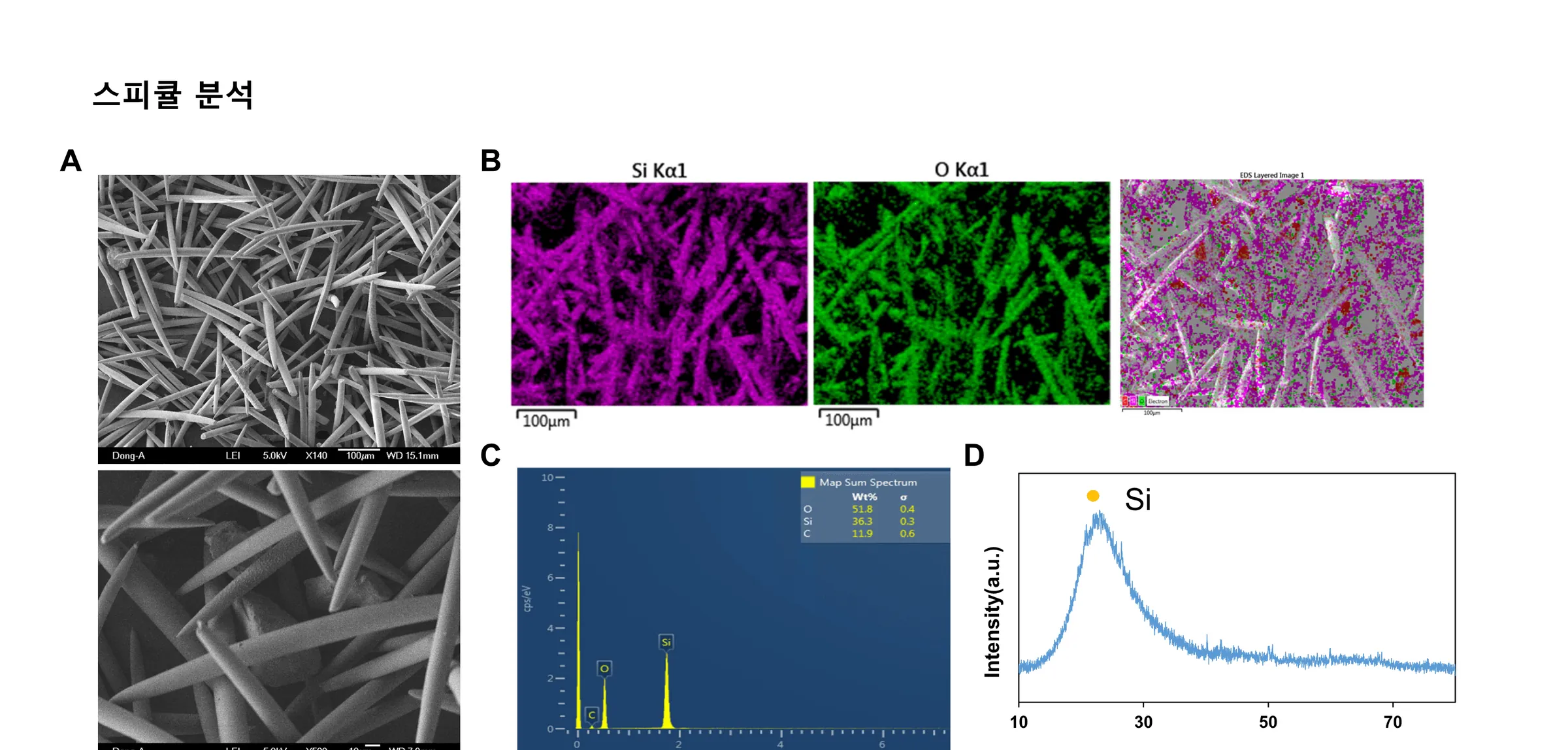
Elemental Composition Analysis
Elemental composition of UNIZ LAB spicules analyzed by Energy Dispersive Spectroscopy (EDS)
* H (hydrogen) is below EDS detection limit. Structural water (·nH₂O) is separately confirmed by FTIR ν(O-H) 3289–3399 cm⁻¹ + thermogravimetric analysis (DTA).
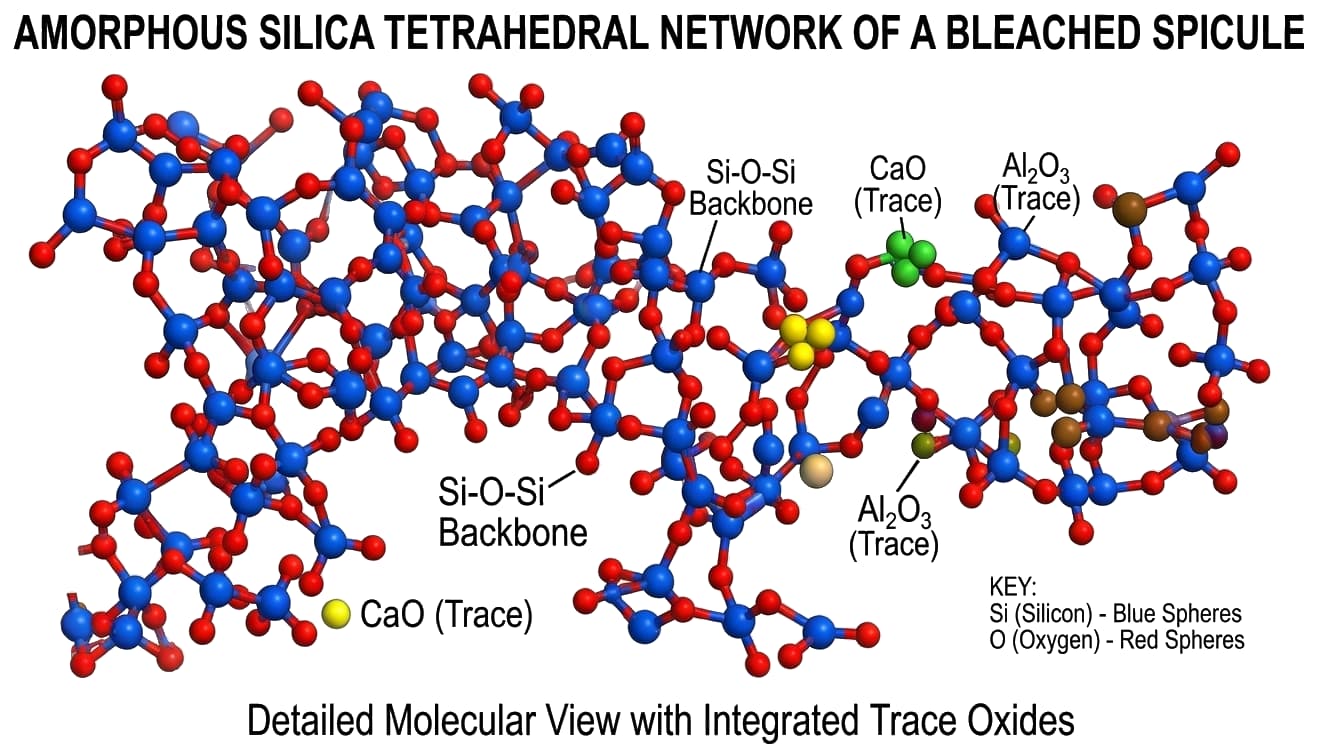
| SiO₂ | SO₃ | Fe₂O₃ | TiO₂ | K₂O | P₂O₅ |
|---|---|---|---|---|---|
| 99.7 | 0.041 | 0.04 | 0.034 | 0.010 | 0.005 |
X-ray fluorescence (XRF) analysis of bleached freshwater sponge spicules. Silicon dioxide is the main constituent; the rest are trace oxides. CaO and Al₂O₃ are excluded because the source paper notes they could arise from sample handling and preparation. The species analysed is an Amazonian freshwater sponge; the compositional ratio of freshwater sponges is nearly identical regardless of region. See reference 9 below.
Analytical Verification — EDS / XRD / NMR
SiO₂·nH₂O molecular structure directly verified by multiple spectroscopic methods — Dong-A University primary measurement data + Drozdov 2021 ²⁹Si NMR analysis.
Q-Group Analysis
Drozdov AL et al. (2021) Applied Sciences. SiO₂·nH₂O bonding structure detected by ²⁹Si NMR — three distinct silicon environments confirmed.
Siliceous Spicule vs Calcareous Spicule
UNIZ LAB uses only Siliceous spicules in all products
| Item | Calcareous Spicule Calcareous (CaCO₃) | Siliceous Spicule (UNIZ LAB) Siliceous (SiO₂·nH₂O) |
|---|---|---|
| Chemical Composition | CaCO₃ (Calcium Carbonate) | SiO₂·nH₂O (Silicon Dioxide) |
| Physical Hardness | Mohs Hardness 3 (Soft) | Mohs Hardness 6~7 (Hard) |
| Acid Resistance | Dissolves upon acid contact | Stable (No reaction) |
| Biocompatibility | Moderate | Excellent (Inorganic silica) |
| Microchannel Effect | Weak | Strong (Rigid structure) |
| Skin Residue | Possible residue | Natural elimination (Safe) |
Why Use Only Siliceous Spicules?
Siliceous spicules have high physical hardness, effectively creating microchannels in the skin and maintaining stability in acidic environments. Additionally, as an inorganic silica material, they are naturally eliminated from the skin without residue, with verified safety.
Hollow Tubular Structure
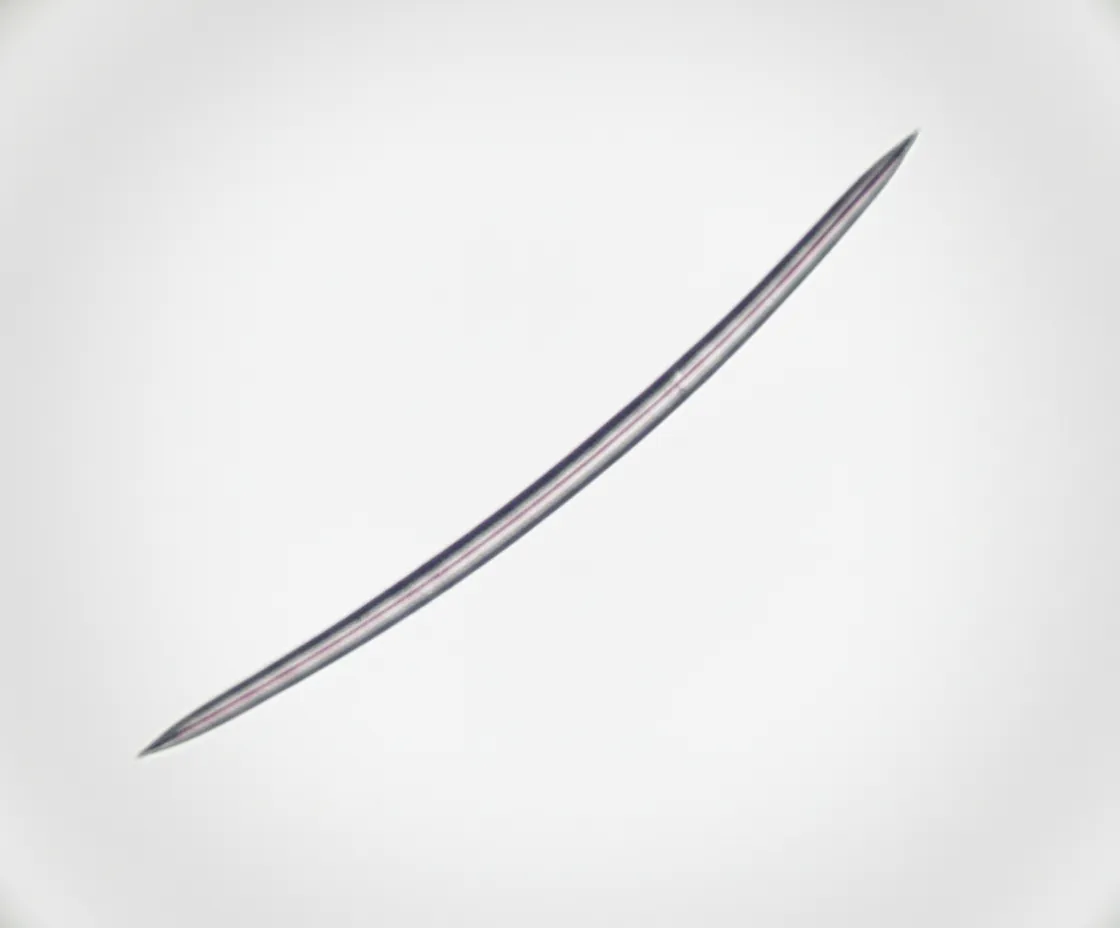
BSPN spicules are not simple rods — they are hollow micro-tubes. The central hollow space (hollow lumen) acts as a conduit for active ingredients, while the outer wall of amorphous silica provides structural stability.
A central axial channel (lumen) surrounded by a wall of amorphous silica. This channel carries the active ingredients.
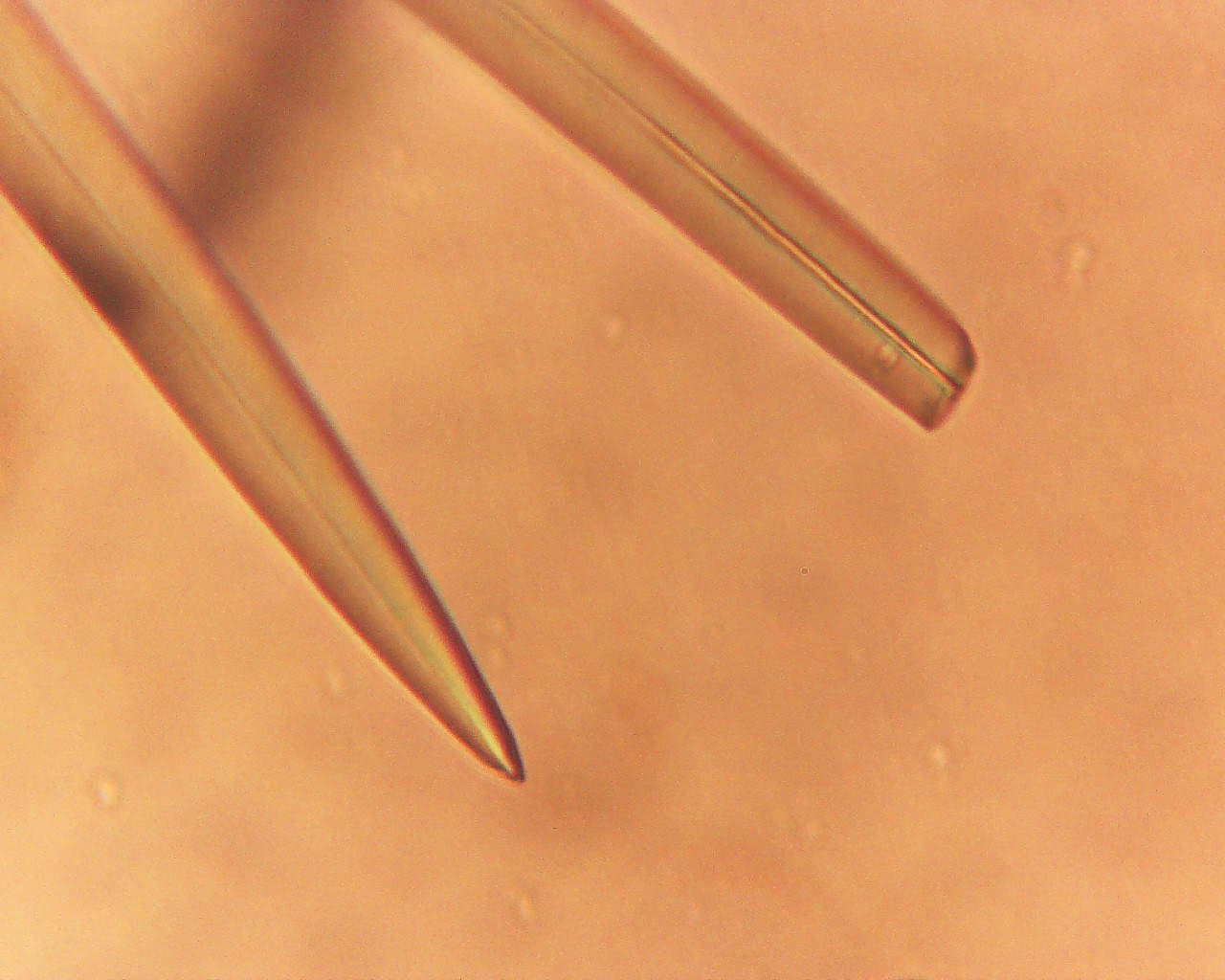
The hollow tube cross-section is directly observable optically at the right spicule tip.
Optical microscopy measurement
1/10 of outer diameter (natural ratio)
270µm ÷ 15µm
| Size | Length | Outer Dia. | Inner Dia. (Lumen) | Aspect Ratio |
|---|---|---|---|---|
| 100 µm | 100 µm | 10 µm | 1.0 µm | 10 : 1 |
| 200 µm | 200 µm | 13 µm | 1.3 µm | 약 15 : 1 |
| 270 µmAbove | 270 µm | 15 µm | 1.5 µm | 18 : 1 |
| 320 µm | 320 µm | 13 µm | 1.3 µm | 약 25 : 1 |
Physical Properties Summary
Verified amorphous (non-crystalline) silica via XRD analysis. IARC Group 3 (not classifiable, safe category) — clearly distinguished from crystalline silica (Group 1, carcinogenic).
Protechkorea Test Report (2022, TriStar II 3020, N₂ adsorption). Smooth natural needle structure characteristic.
UNIZ LAB optical microscopy (×100). Length/diameter ratio by size (~18~22:1 for 270μm grade).
Protechkorea Test Report (2022, AccuPyc II 1340, He gas, 5 cycles, σ ±0.0016).
Academic & Test References
- 1동아대학교 EDS Map Sum Spectrum + XRD 분석. SEM ×100, Si Kα1 + O Kα1 매핑. 비결정질(X-ray Amorphous) 확인.
- 2(주)프로테크코리아 시험보고서 (2022-07-04~05). AccuPyc II 1340 — 밀도 2.0417 g/cm³ (5사이클, σ ±0.0016) / TriStar II 3020 — BET 0.5968 m²/g (N₂ 흡착, −195.85°C).
- 3UNIZ LAB R&D 광학현미경 측정 (×100). 종횡비 10:1~25:1 (사이즈 100~320μm).
- 4Drozdov AL, Zemnukhova LA, Panasenko AE, et al. (2021). Silicon Compounds in Sponges. Applied Sciences, 11(14), 6587. DOI: 10.3390/app11146587. (Direct verification of SiO₂·nH₂O via ²⁹Si NMR + FTIR + XRD + XPS · comparison of 9 sponge species · CC BY 4.0)
- 5Wang X, Schröder HC, Müller WEG (2009). Spicules as blueprints for biofabrication of biomaterials. PMC2755733. (Univ. of Mainz — discoverers of silicatein enzyme, standard reference for molecular structure)
- 6Müller WEG, Wang X, Schröder HC. Giant Siliceous Spicules From Monorhaphis chuni. ScienceDirect (Chapter 3). ("deposited in the form of amorphous opal — SiO₂·nH₂O")
“…according to ²⁹Si NMR data, silicon is in the form of silicon dioxide SiO₂, or polysilicic acid SiO₂·nH₂O.”
Korean: According to ²⁹Si NMR analysis, silicon exists in the form of silicon dioxide (SiO₂) or polysilicic acid (SiO₂·nH₂O).
Significance: Comparative analysis of 9 sponge species (8 marine + 1 freshwater, Lake Baikal) concluded that "the same SiO₂·nH₂O molecular formula applies regardless of sponge species."
- 7IARC Monographs. 비결정질 실리카(amorphous SiO₂) — Group 3 (분류 불가, 안전군). 결정질 실리카(crystalline silica, e.g. quartz) — Group 1 (인체 발암성)과 명확히 구분. CAS 7631-86-9.
- 8Jørgensen CB (1944). On the Spicule-Formation of Spongilla lacustris (L.). Biologiske Meddelelser XIX(7), Det Kgl. Danske Videnskabernes Selskab. — 스피큘은 유기 축사(axial thread)에서 시작해 규산질이 덧붙으며 두께가 자란다.
- 9Jensen M, Keding R, Yue Y. Microscopic Features of Biologically Formed Amorphous Silica. On Biomimetics, IntechOpen. — 담수해면 스피큘의 축방향 채널과 비정질 실리카 골격. 주: 분석 대상은 아마존 담수해면 Cauxi 로, 본 원료의 종(Spongilla lacustris)과 다르다.