Spicule · Ingredient Information
Spicule vs. Industrial Glass Fiber — Differences and How to Tell Them Apart
On the market, industrial glass fiber is sometimes sold under the name “vegan spicule.” To help researchers and users tell them apart for themselves, we have set out the differences between the two materials, the evidence, and ways to check.
There Is No Such Ingredient as “Vegan Spicule”
“Spicule” is the name for the skeletal element that sponges, which are animals, make inside their bodies. Because sponges are animals, spicules obtained from sponges cannot be a vegan ingredient. A fine needle-like material that does not come from a sponge is not called a spicule.
UNIZ LAB spicules are obtained from freshwater sponge, and the INCI name is Hydrolyzed Sponge. Industrial milled glass fiber is molten glass drawn into strands and ground short; it is an industrial material used to reinforce putty and resin.
What Is Industrial Glass Fiber Used For?
Glass fiber is an inexpensive industrial material that anyone can buy from building-material or composite-material suppliers. Short milled glass fiber sells for around KRW 20,000 for a small bag (retail prices checked in November 2026).
- Putty and paste — Mixed into resin to fill cracks and holes.
- FRP (fiber-reinforced plastic) — Used as reinforcement in boats, bathtubs, water tanks, and vehicle parts.
- Plastic filler — Mixed into injection-molded plastic to improve strength and dimensional stability.
- Insulation and sound-absorbing material — Made into cotton-like glass wool and used to insulate buildings.
Four Differences at a Glance
Size
- Spicule
- Length and thickness are set by the sponge species, so the size is regular. UNIZ LAB offers four sizes: 100 · 200 · 270 · 320 µm.
- Glass fiber
- It is strands that have been ground and crushed, so the thickness is even but the lengths vary.
Internal structure
- Spicule
- It is a through-type with a hollow tube (axial canal) running through the center.
- Glass fiber
- It is a solid cylinder.
Composition
- Spicule
- It is biogenic silica with bound water molecules (SiO₂·nH₂O).
- Glass fiber
- It is glass made of silica mixed with aluminum, calcium, and boron oxides.
Origin
- Spicule
- It is made by a living organism.
- Glass fiber
- It is processed in a factory.
Under the Microscope
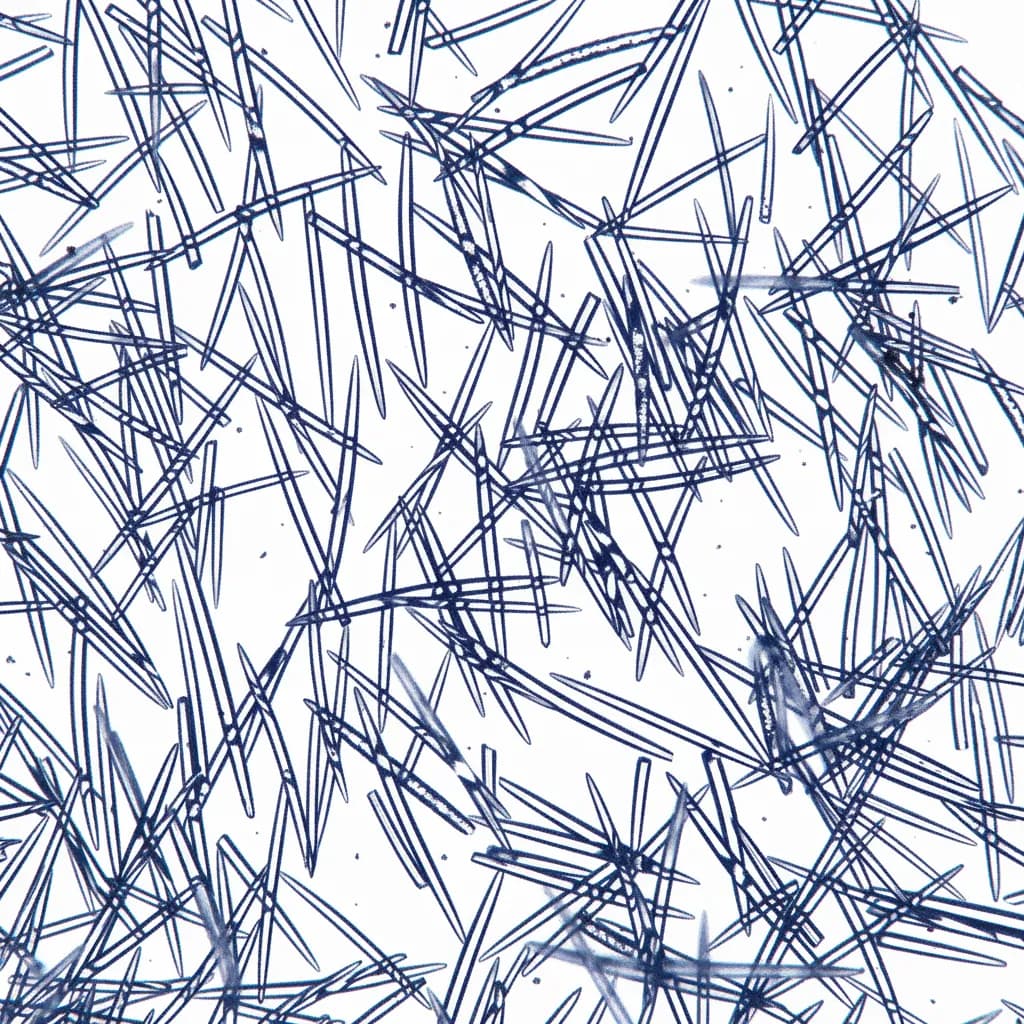
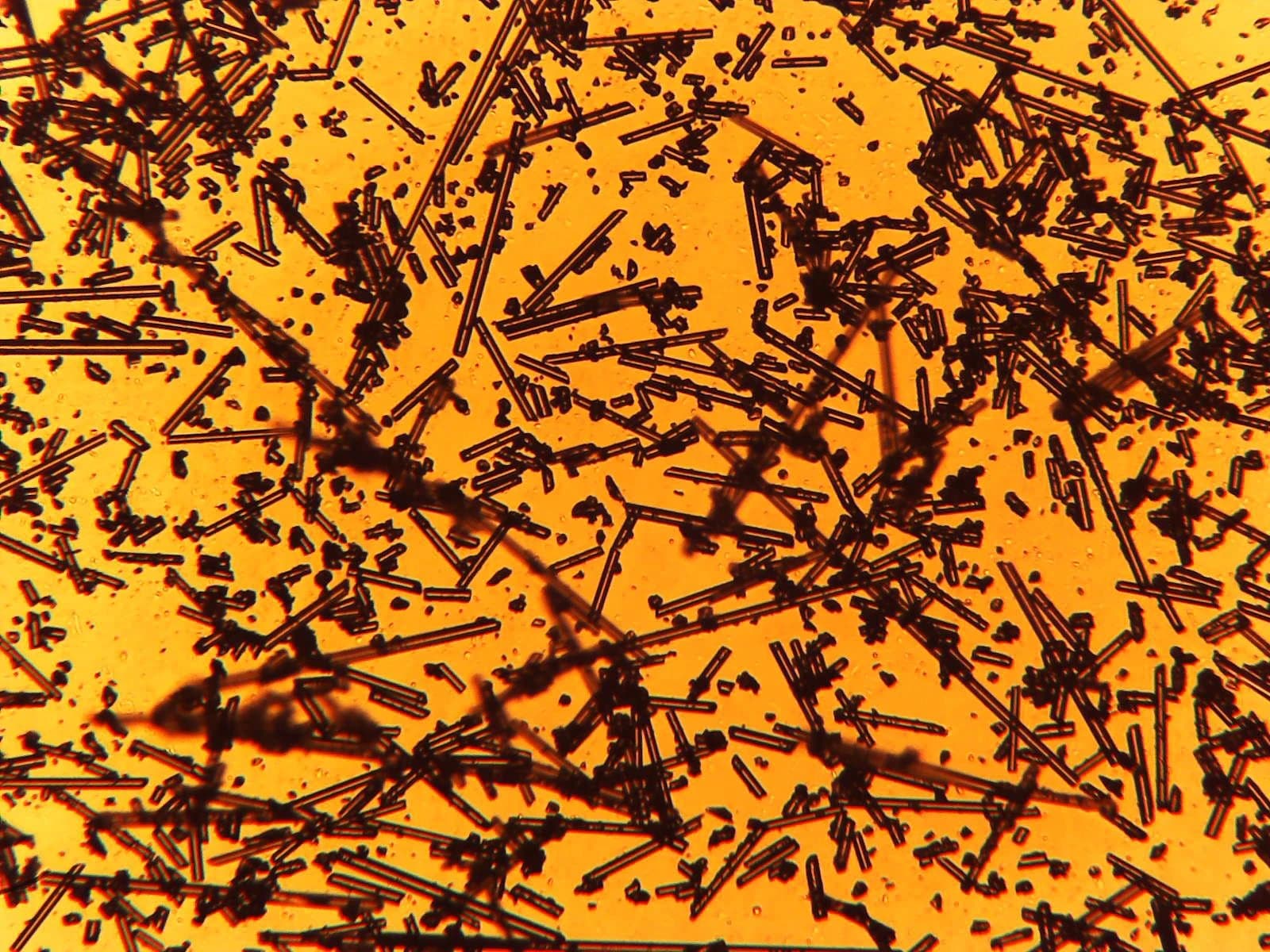
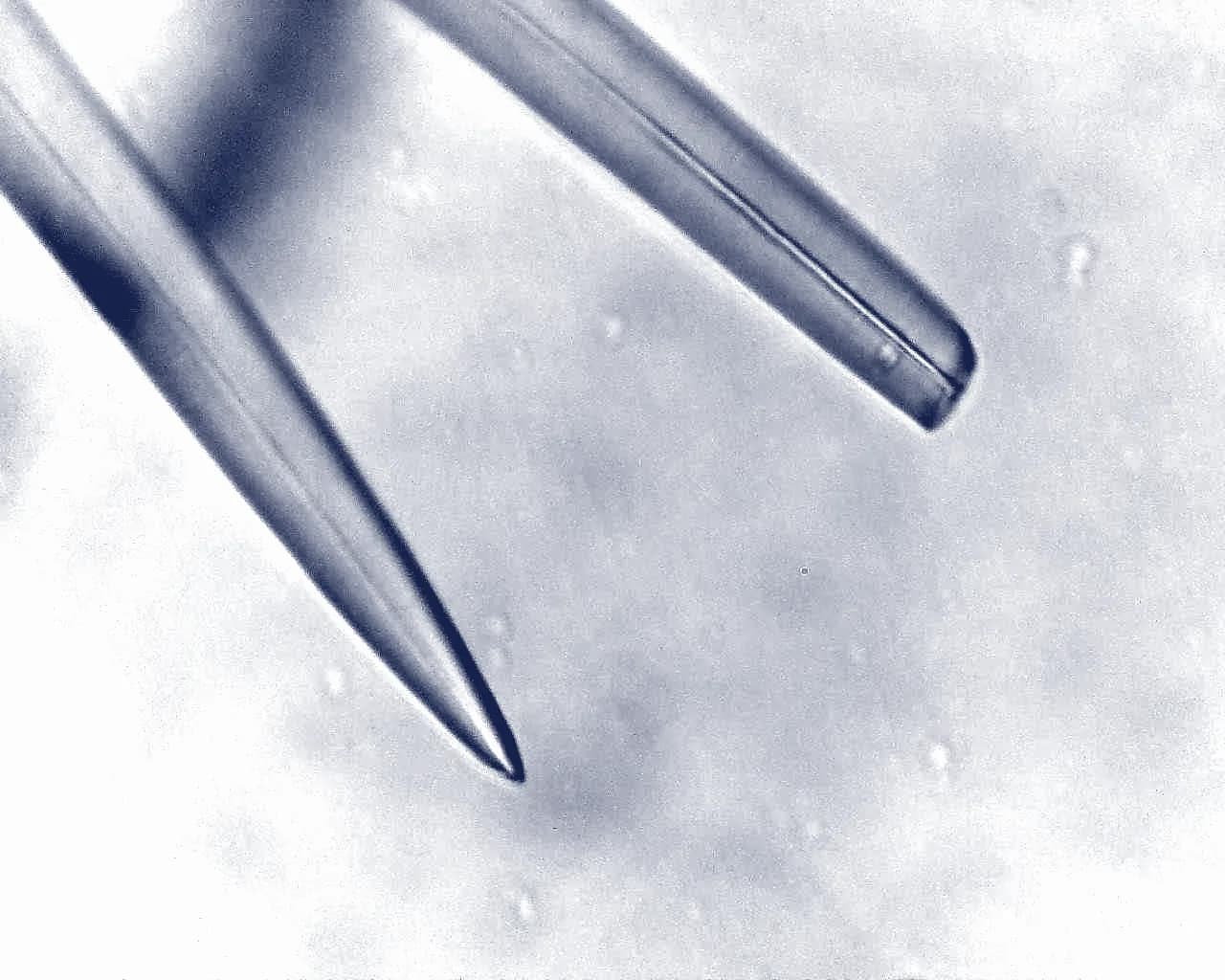
Both photos were taken at the same magnification (×100).
Detailed Comparison
| Item | UNIZ LAB Spicule (Hydrolyzed Sponge) | Industrial Milled Glass Fiber (E-glass type) |
|---|---|---|
| Composition | UNIZ LAB Spicule (Hydrolyzed Sponge)Biogenic silica SiO₂·nH₂O, purity 99%UNIZ LAB R&D (23-step purification) | Industrial Milled Glass Fiber (E-glass type)SiO₂ 52–62 · Al₂O₃ 12–16 · CaO+MgO 16–30 · B₂O₃ 0–10 wt%ASTM D578 (E-glass composition range) |
| Density | UNIZ LAB Spicule (Hydrolyzed Sponge)2.0417 g/cm³Gas displacement pycnometer AccuPyc II · 5 runs · test report 2022 | Industrial Milled Glass Fiber (E-glass type)approx. 2.54–2.56 g/cm³Manufacturer technical data |
| Outer diameter | UNIZ LAB Spicule (Hydrolyzed Sponge)100 µm 10 µm · 200 µm 13 µm · 270 µm 15 µm · 320 µm 13 µmUNIZ LAB optical microscope ×100 | Industrial Milled Glass Fiber (E-glass type)approx. 9–16 µm, even within a single productManufacturer technical data |
| Length | UNIZ LAB Spicule (Hydrolyzed Sponge)Fixed for each size · aspect ratio 10:1 · 15:1 · 18:1 · 25:1Length ÷ outer diameter | Industrial Milled Glass Fiber (E-glass type)Ground and crushed, so lengths vary |
| Interior | UNIZ LAB Spicule (Hydrolyzed Sponge)Through-type with an axial canal running through · inner diameter is about 1/10 of the outer diameterUNIZ LAB measurement | Industrial Milled Glass Fiber (E-glass type)Solid |
| Tip shape | UNIZ LAB Spicule (Hydrolyzed Sponge)Tapers to a sharp point | Industrial Milled Glass Fiber (E-glass type)Flat-cut or broken ends |
| Particle count | UNIZ LAB Spicule (Hydrolyzed Sponge)100 µm 44.6M · 200 µm 16.4M · 270 µm 10.6M · 320 µm 10.3M particles/gUNIZ LAB particle size analysis | Industrial Milled Glass Fiber (E-glass type)— |
| On the skin | UNIZ LAB Spicule (Hydrolyzed Sponge)It stays in the epidermis and sheds off with dead skin cells (48–72 hours · Zhang et al. 2017, animal model). Human patch test N=52, non-irritatingP&K Skin Clinical Research Center | Industrial Milled Glass Fiber (E-glass type)It is known to cause “fiberglass dermatitis,” an occupational irritant contact dermatitis. Pieces embed in the skin and irritate it mechanically.Camacho et al. 2019 |
| Workplace control | UNIZ LAB Spicule (Hydrolyzed Sponge)Handle the raw-material powder according to the MSDS | Industrial Milled Glass Fiber (E-glass type)It is subject to workplace exposure limits. ACGIH TWA (continuous filament glass fiber) 1 f/cc · 5 mg/m³.Korean study on establishing and revising exposure limits |
| Original use | UNIZ LAB Spicule (Hydrolyzed Sponge)Cosmetic ingredient | Industrial Milled Glass Fiber (E-glass type)Industrial material such as putty and resin reinforcement |
This table is a factual comparison. It does not pass judgment on any specific product or company.
Caution
Caution
How to Tell Them Apart Yourself
Optical microscope (×100–×400)
This is the easiest. In a spicule you can see the axial canal in the center, the tip is sharp, and length and thickness are even within the same size. Glass fiber has no axial canal, its ends are flat or broken, its lengths vary, and angular fragments are mixed in.
True density
Measure it with a gas displacement pycnometer. Spicules are about 2.04 g/cm³ and E-glass is about 2.54 g/cm³.
Thermogravimetric analysis (TGA) or loss on ignition
Spicules lose weight as the bound water leaves. Glass fiber loses only as much as the sizing (surface treatment agent) coated on the outside burns off.
Composition analysis (XRF · ICP · SEM-EDS)
If aluminum and calcium show up at more than a few percent, it is glass. Boron is hard to detect by EDS, so check it by ICP.
Documents
Obtain the INCI name and a certificate of origin. The INCI name for sponge spicules is Hydrolyzed Sponge.
Frequently Asked Questions
- Is there such a thing as “vegan spicule”?
- No. “Spicule” is the name for the skeletal element of sponges, and sponges are animals. A needle-like ingredient labeled “vegan” is a different material that is not from a sponge, so its composition and shape should be checked.
- Aren’t glass fiber and spicules both silica?
- The only thing they share is that silica is in the main composition. Spicules are biogenic silica with bound water molecules, while glass fiber is glass mixed with aluminum, calcium, and boron oxides. Density, internal structure, and tip shape also differ.
- How can I check whether the ingredient I received is a spicule?
- First look for the axial canal and the sharp tip under an optical microscope. To be certain, also check the true density and composition analysis.
References
- ASTM D578/D578M-23, Standard Specification for Glass Fiber Strands — E-glass composition range
- Camacho I, Rajabi-Estarabadi A, Eber AE, et al. Fiberglass dermatitis: clinical presentations, prevention, and treatment — a review of literatures. Int J Dermatol 2019. PMID 30816574 · DOI 10.1111/ijd.14407
- IARC Monographs Vol. 81 (2002), Man-made Vitreous Fibres
- Korea Industrial Health Association (principal investigator Choi Ho-chun). Summary of the exposure limit establishment/revision study “60. Glass Fiber” (2005 study). Ministry of Employment and Labor policy data room, posted 2006-03-27. moel.go.kr
- Manufacturer technical data (Milled glass fibre 0.2 mm · E-glass density and fiber thickness)
- UNIZ LAB R&D Data — purity, outer diameter, inner diameter, particle count · Protech Korea Co., Ltd. test report (2022) true density · P&K Skin Clinical Research Center human patch test
Need spicule samples?
Choose a size and request samples, then compare the material under a microscope yourself.