Coating & Impregnation
Spicule
UNIZ LAB's proprietary technology directly coats and impregnates active ingredients onto the Spicule surface. This precision process — exclusive to water-soluble ingredients — maximizes skin delivery efficiency.
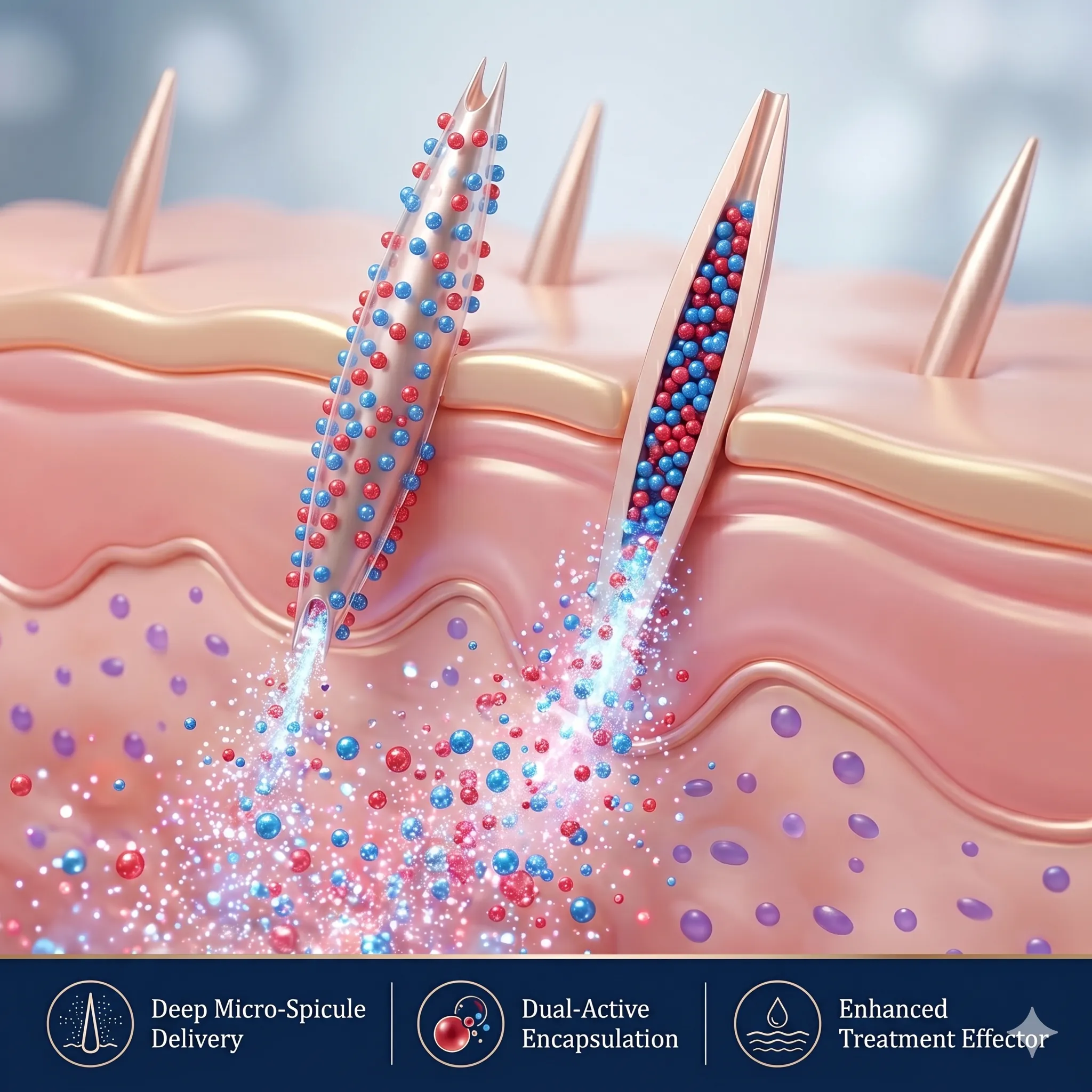
Two Delivery Methods,
At a Glance
- Left — Coating:
Active particles attached to the Spicule surface. Immediate surface release upon skin penetration
- Right — Impregnation:
Active filled into the Spicule's internal hollow cylindrical structure (lumen). Gradual Controlled Release
Step-by-Step Process Visualization
All of UNIZ LAB's Coating & Impregnation processes are Aqueous-phase precision processes free of organic solvents. No organic solvents are used at any step — a precision process that binds water-soluble active ingredients to the Spicule.
Coating Process — 4 Steps
Dry Spicule Preparation
23-step refined White Spicule (99%) prepared in dry state
Active Ingredient + Purified Water
Water-soluble actives (HA, Peptides, Niacinamide, etc.) dissolved in purified water
Surface Binder + Purified Water
Proprietary binding polymer mixed in purified water → mediates active-to-Spicule surface binding
Spicule Immersion → Drying
Spicules immersed in the mixed solution, then standard drying. A uniform active coating layer forms on the surface
Impregnation Process — 2 Steps
Spicule Immersion
Dry Spicules immersed in diluted purified water containing dissolved active ingredients
Low-Temperature Vacuum Drying + Heating
Transferred to a low-temperature vacuum dryer, then heated. Vacuum removes internal air → active is drawn into the lumen → after drying, internal filling is complete
| Category | Coating | Impregnation |
|---|---|---|
| Binding Location | Spicule surface | Spicule internal lumen (hollow cylinder) |
| Process Steps | 4 steps (mixing · immersion · drying) | 2 steps (immersion · vacuum heat drying) |
| Surface Binding Method | Polymer Binder mediated (surface electrostatic & hydrogen bonds) | Solvent evaporation leaves only the active inside the lumen |
| Drying Method | Standard drying (room temperature) | Low-temperature vacuum heating (<60°C) |
| Release Pattern | Immediate surface release | Time-delayed release (Controlled Release) |
| Efficacy Onset | Instant | Long-lasting |
Coated Spicule Visualization
Uniform surface coating distribution verified with fluorescence-labeled actives
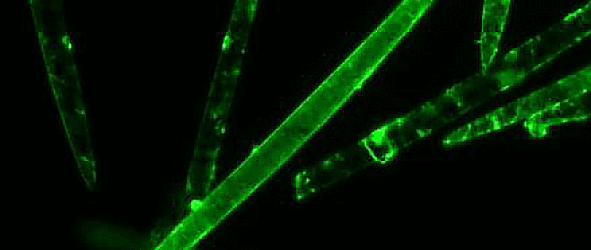
Fluorescence-Labeled Active Coating
Direct observation of uniform coating distribution on the Spicule surface via fluorescence microscopy
Surface Coated Spicule
Surface-Coated Spicule (SEM)
Please add an image
Impregnated Spicule
Impregnated Spicule cross-section (SEM)
Please add an image
Water-Soluble Actives Available for Coating & Impregnation
Extracted from all 12 AUIN formulations, 48 water-soluble actives. Excludes bases, oil phases, and acids (AHA/BHA/PHA).
Hydration · Barrier
· 10itemsCoating & Impregnation Ingredient Overview
* Water-soluble ingredients outside this list can also be coated upon client request (pre-testing required)
Academic & Technical References
- UNIZ LAB R&D Data: Coating & Impregnation process data for 48 water-soluble actives — vacuum-reduced-pressure impregnation + ultrasonic penetration + wet coating, three-stage process.
- Transdermal Delivery System (TDS): Prausnitz, M. R., & Langer, R. (2008). Transdermal drug delivery. Nature Biotechnology, 26(11), 1261-1268.
- Microneedle DDS: Waghule, T., et al. (2019). Microneedles: A smart approach. Biomedicine & Pharmacotherapy, 109, 1249-1258.
Coating & Impregnation Spicule Inquiry
We welcome consultations on Coating & Impregnation of water-soluble active ingredients. Custom coating also available.